

🧠 Do I Need a Math Background to Understand Machine Learning?
Not really.
If you can spot patterns, reason through outcomes, and stay curious — you're already thinking like a machine learning engineer.
Let’s go deeper and clarify the concepts behind AI, ML, Deep Learning, Neural Networks, and the different learning types.
What is Artificial Intelligence (AI)?
AI is the science of simulating human intelligence in machines — enabling them to perceive, reason, learn, and act.
AI is the umbrella term that covers:
Logic-based systems (if-this-then-that rules)
Search algorithms (path finding, optimization)
Machine learning
Computer vision
Natural language processing (NLP)
AI systems are typically designed to:
Solve complex problems
Make decisions under uncertainty
Improve performance over time
Think of AI as the overall goal: to build machines that behave intelligently.
What is Machine Learning (ML)?
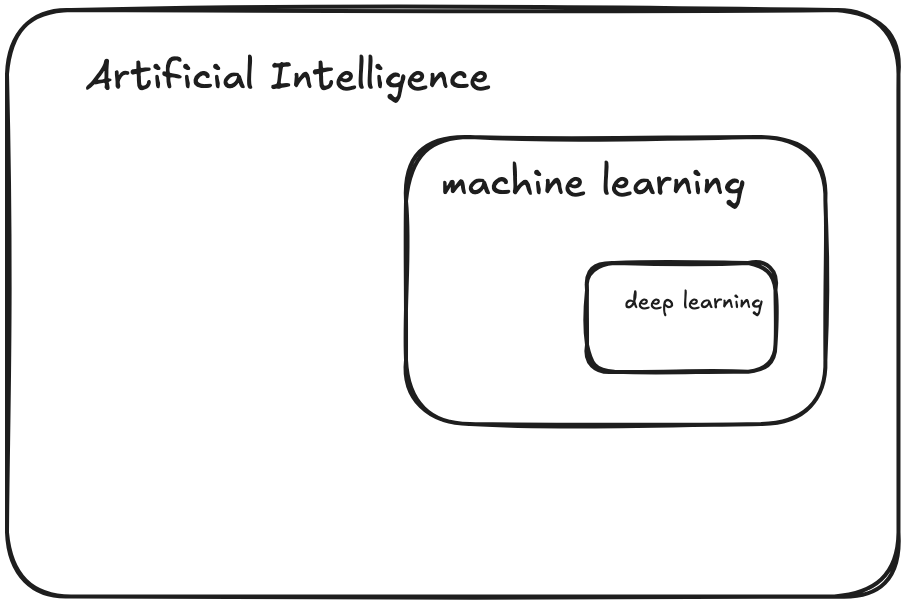
Machine Learning is a subset of AI focused on building systems that learn from data rather than being explicitly programmed.
The goal?
To create models that can generalize from past data to make accurate predictions on new data.
Key Ingredients:
Data: Historical records, logs, sensor readings, images, etc.
Features: The input attributes or variables (e.g., age, salary)
Labels: The outcomes we want to predict (e.g., will churn: yes/no)
Model: A mathematical representation of the pattern between inputs and outputs
You give the model labeled examples (features + labels), and it learns the mapping.
ML is all about pattern recognition and generalization.
What is Deep Learning?
Deep Learning is a subfield of machine learning that uses neural networks with many layers — hence deep.
It excels when the data is:
Large scale (millions of samples)
Unstructured (text, audio, images, video)
Nonlinear and complex (like natural language or vision)
Examples:
Image classification (cat vs dog)
Text summarization
Text-to-image generation
Voice synthesis
Deep learning models:
Learn hierarchical representations
Require large datasets and powerful compute (GPUs/TPUs)
Are difficult to interpret, but very effective
What Are Neural Networks?
Inspired by the brain, artificial neural networks (ANNs) consist of layers of neurons connected by weights.
Each neuron:
Receives input(s)
Applies a weight and bias
Passes it through an activation function (like ReLU, sigmoid)
Sends it to the next layer
Key Terminology:
Input layer: where features come in
Hidden layers: where learning happens
Output layer: final prediction
During training, the model adjusts the weights using an optimization algorithm like gradient descent to minimize the prediction error (via a loss function).
Special Neural Architectures:
CNNs (Convolutional Neural Networks): for images
RNNs (Recurrent Neural Networks): for sequential data
Transformers: for NLP (used in ChatGPT, BERT, LLaMA, etc.)
Types of Machine Learning
Machine learning problems fall into three primary types, based on the kind of feedback the model receives:
1. Supervised Learning
The model is trained on a labeled dataset — meaning we give it both inputs and correct outputs.
Goal: Learn the mapping from input → output
Use cases:
Predicting housing prices
Detecting fraud
Classifying emails as spam/not spam
Types:
Regression (continuous output): e.g., price prediction
Classification (categorical output): e.g., spam or not spam
2. Unsupervised Learning
No labels are provided — the model has to discover hidden patterns or structures in the data.
Goal: Group, compress, or represent data
Use cases:
Customer segmentation
Topic modeling
Anomaly detection
Types:
Clustering: e.g., K-means, DBSCAN
Dimensionality reduction: e.g., PCA, t-SNE, UMAP
3. Reinforcement Learning (RL)
An agent learns to take actions in an environment to maximize reward.
It learns through trial and error, receiving feedback as rewards or penalties.
Goal: Learn optimal policy for decision-making
Use cases:
Robotics
Self-driving cars
Game AI (Chess, Go, Dota, StarCraft)
Core Concepts:
Agent: the learner
Environment: the world it interacts with
Reward: numerical feedback signal
Policy: the strategy the agent follows
How It All Fits Together
Do You Need Math or Coding?
Here’s the truth:
You’ll eventually need some math (linear algebra, stats, calculus)
You’ll need basic Python skills
But you can learn both as needed, especially with modern tools (e.g., Scikit-learn, Hugging Face, PyTorch Lightning)
Start by:
Building small projects
Using low-code tools (like Teachable Machine, Runway ML)
Reading real-world examples
Final Thought
Machine learning isn’t about math or magic — it’s about mindset.
If you can think in patterns, reason through outcomes, and stay curious — you’re already equipped to get started.