
I Built the GPU Infrastructure Course I Wished Existed
What most engineers miss below the application layer

When I started managing GPU clusters on Kubernetes, the learning curve was brutal.
The official docs tell you how to install the NVIDIA device plugin. They don’t tell you what happens when the GPU Feature Discovery pod crashes silently and your scheduler stops placing GPU workloads.
They don’t tell you that running etcd on the same nodes as your GPU workloads will create latency spikes that look like application bugs. They don’t tell you that a 7B model on an A100 wastes 90% of a $30K card unless you configure MIG properly.
I learned all of this the hard way. Running H100 clusters in production, debugging at 2 AM, reading NVIDIA docs that assume you already know the answer.
That’s why I built this course.
GPU Infrastructure on Kubernetes is a structured, text based course that covers everything from the NVIDIA GPU Operator internals to production model serving — with the depth that KubeNatives readers expect, plus step by step walkthroughs, exercises, and production checklists.
Here’s what it covers:
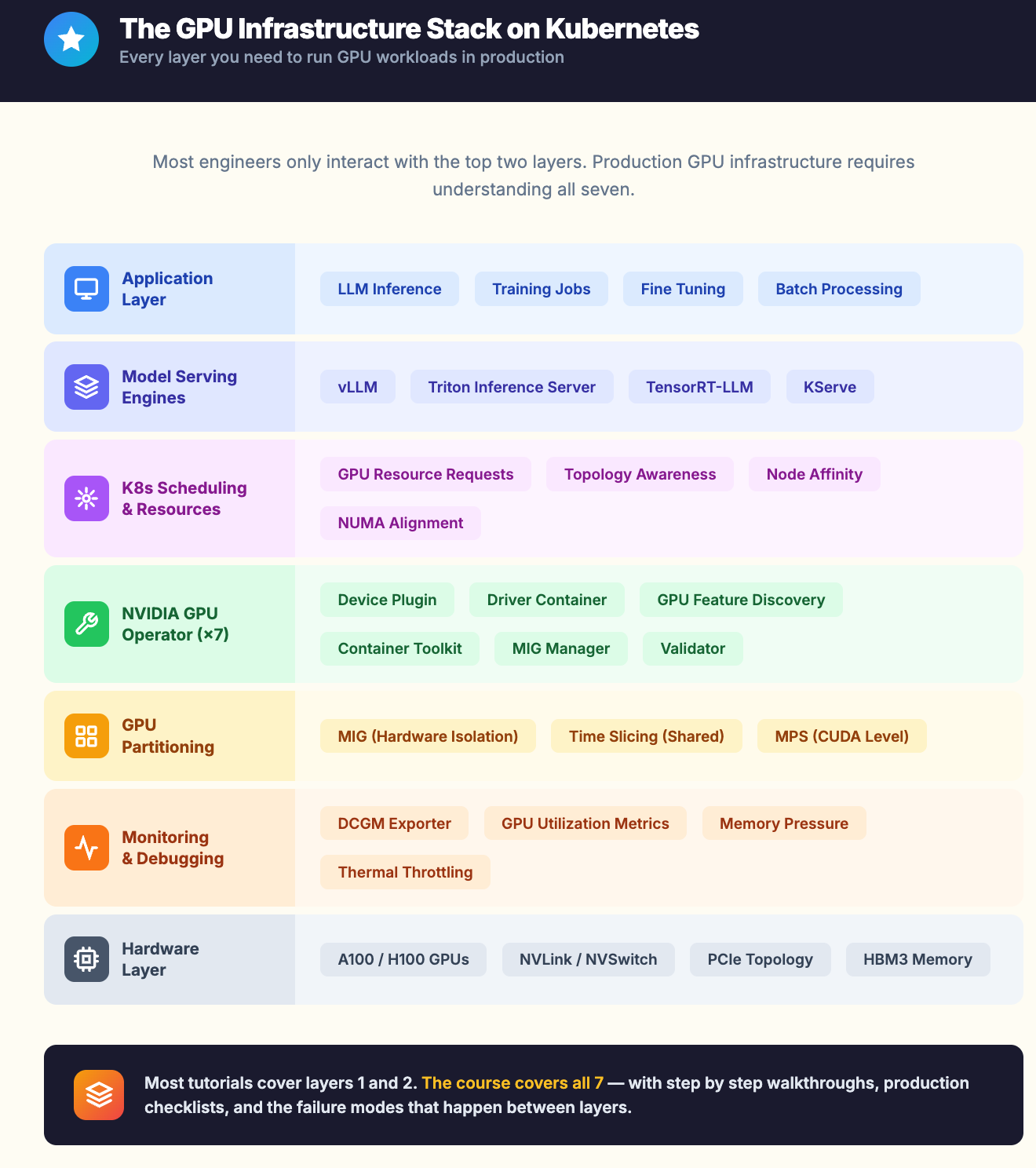
The GPU Operator deep dive. All 7 components. What each one does, how they depend on each other, and how to debug when one fails. Most engineers only know about the device plugin. This section covers the other 6 that actually cause your production issues.
GPU partitioning strategies. MIG, time slicing, and MPS explained with real configuration examples. The decision framework for choosing between them. Cost modeling so you can calculate exactly how much you’re wasting with whole GPU allocation.
Scheduling and resource management. How K8s GPU scheduling actually works under the hood. Topology awareness, NUMA alignment, and why pod placement matters for inference latency. The configs that took our p99 from 200ms to 40ms.
Model serving on GPU nodes. vLLM and Triton deployment patterns. Resource requests that actually make sense for inference workloads. Autoscaling GPU workloads without the cold start penalty.
Monitoring and debugging. DCGM metrics that predict failures before they happen. The GPU pod pending decision tree. Memory pressure debugging. Thermal throttling detection.
Production checklists and failure modes. Every section ends with a checklist you can use in your own clusters and a catalog of the failure modes I’ve encountered. These alone will save you dozens of debugging hours.
This isn’t a weekend tutorial. It’s the course I wished existed when I started running GPU infrastructure. Every section is 3 to 4 times deeper than the newsletter articles they’re based on, with exercises and real production scenarios.
The course is live now at devopsbeast.com
If you’ve been reading KubeNatives every week — this is the full picture, structured so you can go from zero GPU experience to confidently running production GPU workloads.