
The Course Platform I Wish Existed When I Was Interviewing for DevOps Roles
GPU infrastructure, Kubernetes security, LLM operations, performance tuning, and identity systems, taught through real interview scenarios

The Course Platform I Wish Existed When I Was Interviewing for DevOps Roles
Today I’m launching DevOpsBeast, a course platform for senior DevOps engineers preparing for interviews at FAANG and other top tier tech companies. It teaches the design first reasoning that real interviews test: Kubernetes architecture, GPU infrastructure, LLM operations, security, performance tuning, and identity systems.
This has been quietly building in the background for the past few months, and I want to walk you through what’s inside, why I built it, and what’s coming next.
Why I Built This
Most DevOps interview prep is broken.
You either get tutorial videos that teach you tools without context, or you get LeetCode-style problem sets that have nothing to do with what interviewers actually ask. Neither prepares you for the moment when a senior engineer says, “Your cluster is slow. What do you do?”
That question doesn’t have the right answer. It has the right approach. And the difference between candidates who get hired at FAANG-level companies and candidates who don’t is whether they can demonstrate that approach in 45 minutes of high-pressure design conversation.
So I built DevOpsBeast.
It’s a course platform focused on one specific thing: teaching the design-first reasoning that senior DevOps interviews actually test.
What’s Inside
Every course follows the same format. Realistic scenarios, architecture design, technical reasoning, trade-off analysis, and the actual interview questions that come from these scenarios at companies like Atlassian, Netflix, Stripe, and the FAANG names you’d expect.
Here’s what’s live or in active development:
Production GPU Infrastructure on Kubernetes. Running GPU workloads at scale. Driver management, MIG, time slicing, multi tenancy, cost optimization, and the architecture decisions that separate a working setup from a production one. This is the course that’s most relevant if you’re moving into AI/ML platform work.
LLM Operations for MLOps Engineers. 30 essential LLM concepts taught through the lens of operating them at scale. Inference serving, RAG architectures, agent infrastructure, hallucination detection, cost engineering. Not how to train models. How to deploy, monitor, and defend them in production.
Kubernetes Security. 40 lessons covering the full attack surface and defense layers. The Kubernetes API, RBAC, STRIDE threat modeling, Pod Security Admission, network policies, runtime detection, supply chain security, incident response. Every lesson starts with a breach scenario and walks through both the attack and the defense.
Kubernetes Performance Optimization. The course I wish I’d had when I first hit “the cluster is slow” and didn’t know where to look. Control plane tuning, etcd performance, scheduler throughput, resource right sizing, CPU throttling, network and storage performance, autoscaling deep dives, and dedicated optimization for EKS, GKE, and AKS.
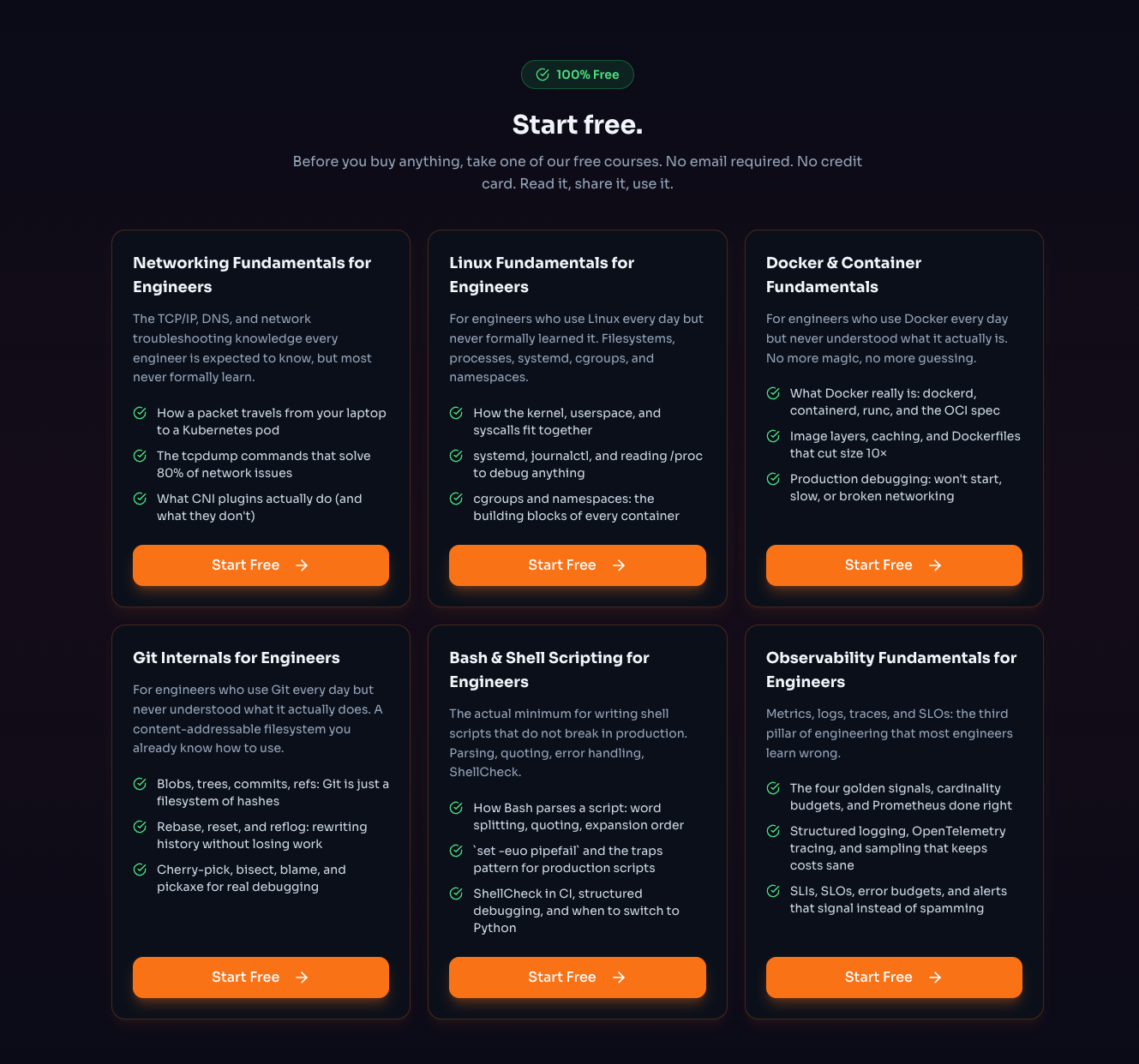
Free Courses (Linux Fundamentals plus Networking Fundamentals). These are the prerequisites for everything else. Free, no email required, available right now.
Why This Matters Now
DevOps interviews have shifted in the last two years.
Companies aren’t asking “do you know how to write a Dockerfile” anymore. They’re asking “design a multi tenant Kubernetes platform that supports 200 teams with proper isolation, cost attribution, and security boundaries.” They’re asking “your inference latency is 3 seconds and the team needs it under 500ms, diagnose and fix.” They’re asking “we just had a security breach in our CI/CD pipeline, walk me through your incident response.”
These are senior staff and principal level questions. And the engineers who answer them well aren’t the ones who memorized more tools. They’re the ones who can reason through novel scenarios using frameworks they’ve internalized.
That’s what I’m trying to teach.
The Companion Resources
I’ve also been writing a blog at devopsbeast.com/blog covering debugging scenarios that don’t fit neatly into a course. The latest one is about Kubernetes certificate expiry, the silent killer that takes down production at 2 AM with no warning. If you’ve never been hit by it, bookmark that post before you do.
And I’m posting interview-related content on LinkedIn most days. Real questions, model answers, common misconceptions. If that’s useful, follow me there.
What’s Next
Over the next few months, I’ll be filling in lessons, adding new courses (security engineering deep dives, observability for distributed systems, platform engineering interview prep), and publishing more of these debugging blog posts.
If you’re preparing for a senior DevOps role or just want to deepen your design-first thinking, head over to devopsbeast.com and explore.
Thanks for reading. As always, hit reply if you have questions, feedback, or specific topics you want me to cover.
Sharon
P.S. The free courses (Linux Fundamentals, Networking Fundamentals) are genuinely free and don’t require an email signup. They’re meant to be useful on their own, even if you never look at the paid stuff. Start there if you want to see how I teach.
Read devopsbeast blog here