


Most people think MLOps is just DevOps with more math. That’s wrong.
To become a great MLOps Engineer, you don’t need to master calculus, probability theory, or derive the backpropagation algorithm.
You need to understand machine learning workflows and build reliable, scalable infrastructure that supports them.
What You Do Need to Understand
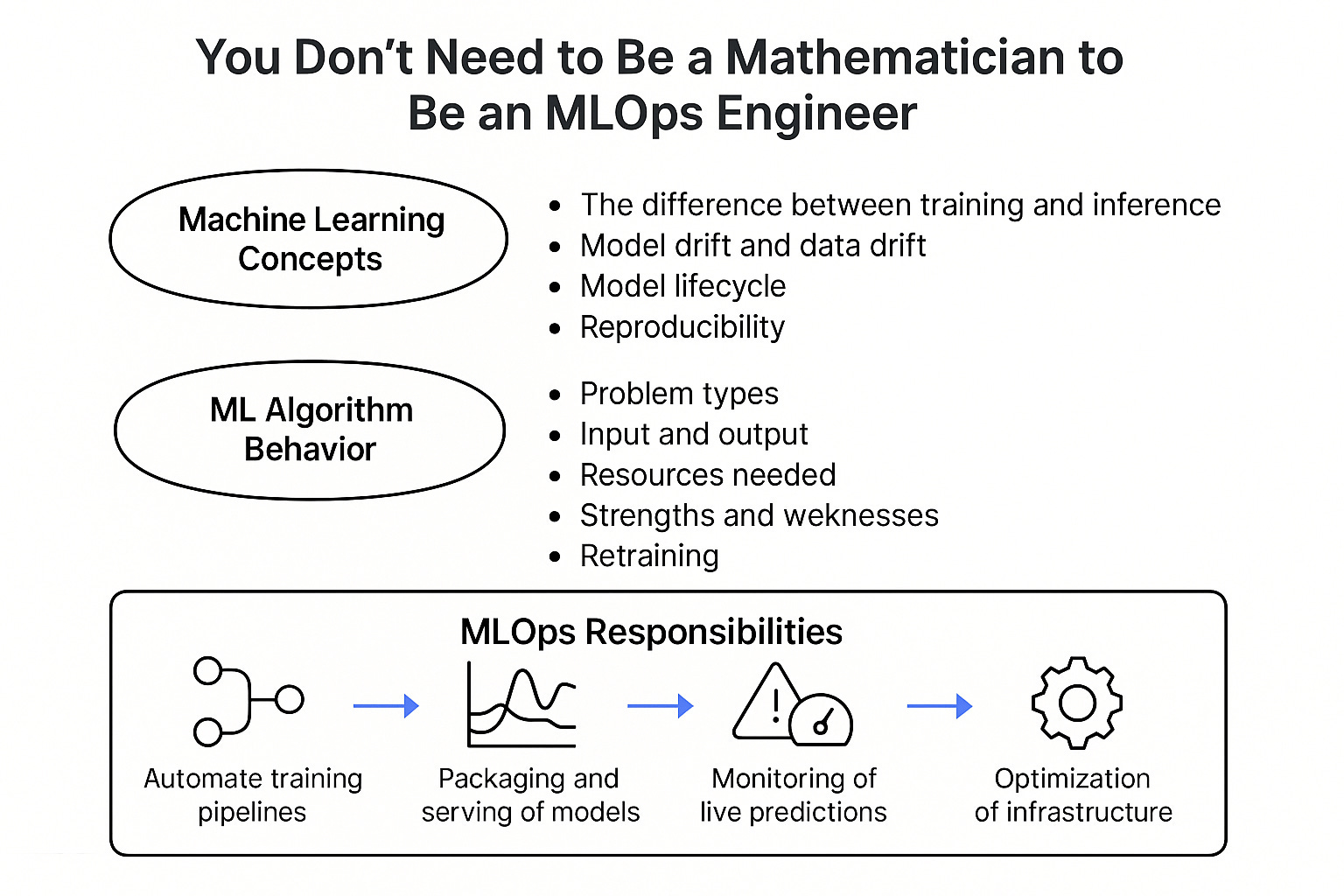
1. Machine Learning at a High Level
You need to understand:
The difference between training and inference
What model drift and data drift mean
The lifecycle of a model: experiment → train → validate → deploy → monitor → retrain
Why reproducibility matters (same code + same data = same result)
2. How ML Algorithms Behave (Not How They're Built)
You must understand:
What type of problem an algorithm solves (classification, regression, clustering)
The structure of its input and output
Its resource requirements (CPU/GPU, memory, time)
Its strengths and weaknesses (e.g., random forests overfit less, deep models need more data)
When it’s time to retrain or switch the model
You don’t need to:
Derive the equations behind it
Understand optimization theory
Tune hyperparameters manually
📦 You don’t need to invent the algorithm. You need to understand how to productionize it.
What You Really Do as an MLOps Engineer
Your job is to:
Automate training pipelines (Argo Workflows, Airflow, Kubeflow Pipelines)
Track models (MLflow, DVC, Weights & Biases)
Package and serve models (BentoML, KServe, vLLM, FastAPI)
Monitor live predictions (latency, confidence, distribution, drift)
Secure infrastructure (data access, secrets, audit logs)
Optimize performance and cost (GPU scheduling, autoscaling, caching)
You build the system. Not the model.
Tools You’ll Work With
Layer Tools Training Pipelines Argo, Airflow, Kubeflow Model Tracking MLflow, W&B, DVC Model Serving BentoML, KServe, vLLM Infra Kubernetes, Docker, Terraform Monitoring Prometheus, Grafana, Evidently AI
Core Skill: Systems Thinking
If you understand how to move data, track models, deploy them, monitor behavior, and iterate safely—you’re doing MLOps.
It’s not about equations. It’s about reliability.
Summary
You don’t need to be a mathematician to be an MLOps engineer.
You need to be a systems engineer who understands ML workflows.
Focus on:
Infrastructure
Automation
Observability
Data flows
Let the researchers handle the math.
Your job is to make the model work—in production.